
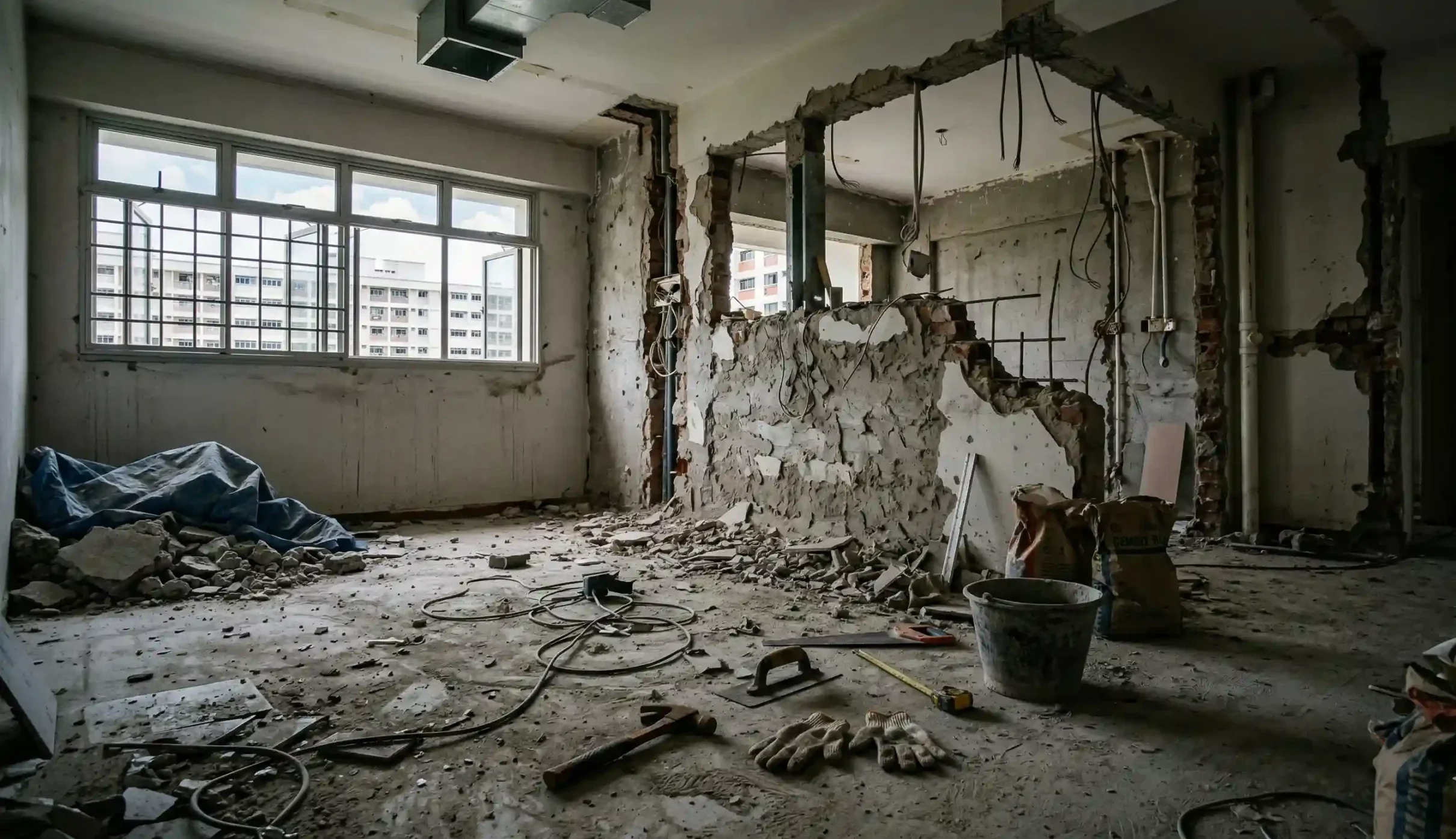
Every year, Singapore homeowners suffer significant financial losses from renovation fraud. Some lose their deposit before a single wall is hacked. Others pay progressively, only for their ID to disappear halfway through. In almost every case, the warning signs were there before the first payment was made.
This guide covers how to identify a renovation scam before you sign anything, how to vet your interior designer properly, what to do in the first 48 hours if things go wrong, and why the difference between a scam and poor workmanship changes everything about your options.
What Is a Renovation Scam in Singapore — and What Is Not
Before you can protect yourself from a renovation scam, you need to understand what one actually is. This distinction matters because it determines which authority you contact, what evidence you need, and what recovery is realistic.
A renovation scam involves deliberate intent to defraud. The interior designer or renovation company takes your money without ever intending to complete the work. Common patterns include collecting a large deposit and disappearing, using a fake or borrowed portfolio to win the job, operating under a shell company with no real capacity to renovate, and rebranding after complaints by registering a new company under a different name.
Poor workmanship is different. Your ID completes the renovation but the quality is substandard — tiles are uneven, cabinets are poorly fitted, or promised finishes do not match what was delivered. This is a contractual dispute, not a criminal matter. Your recourse options are different and so is the process for pursuing them.
The distinction matters because a police report is only appropriate for criminal fraud, not workmanship disputes. Filing a police report against an ID who delivered poor tiling does not help you and wastes time you could spend pursuing the right channel.
How to Tell the Difference Before It Is Too Late
Most renovation scams follow recognisable patterns. Here is what to watch for before you sign anything.
Warning sign 1
Quote 25 to 40% below every other firm
A quote that is far below market rate for the same scope is not a bargain. It is either a loss-leader to secure the deposit or a sign the company lacks the capacity to deliver. Legitimate interior design firms in Singapore price within a predictable range for a given scope of work.
Warning sign 2
Large upfront deposit demand
The industry norm for an initial deposit in Singapore is 10 to 20% of the total renovation cost. Any demand for 30%, 40%, or 50% upfront before work begins is a significant red flag. For the full breakdown of what a safe deposit looks like by flat type, see our guide to interior design payment in Singapore.
Warning sign 3
Cash only or personal bank account
All legitimate payments should go to the interior design firm’s registered company account. A personal bank account has no legal connection to the business. Cash leaves no paper trail. If your ID cannot accept a bank transfer to a business account and issue an official receipt, do not proceed.
Warning sign 4
Vague or verbal contract
A legitimate renovation contract in Singapore is detailed. It itemises the scope of work, materials, timeline, payment schedule tied to milestones, and variation order process. If your ID resists putting things in writing or sends a one-page summary and calls it a contract, that is a warning sign.
Warning sign 5
Portfolio cannot be verified
Ask for the addresses of two or three completed projects and request permission to contact the previous homeowners. A legitimate ID with a genuine track record will have no problem with this. Resistance to portfolio verification is one of the strongest pre-signing warning signs you will encounter.
Warning sign 6
Newly registered company with very low paid-up capital
You can check any Singapore company’s registration status, paid-up capital, and director history on ACRA BizFile+ at no cost. A company incorporated less than 12 months ago with paid-up capital below $10,000 is a meaningful risk signal — not disqualifying on its own, but worth noting alongside other flags.
The 5 Non-Negotiable Checks Before You Pay Anything
These checks take less than 30 minutes in total. Do all five before signing a contract or transferring any money.
Check 1: ACRA BizFile+
Go to bizfile.acra.gov.sg and search the company name. Confirm the company is active, note the date of incorporation, check the paid-up capital, and look at the director’s history. If a director appears on multiple recently dissolved companies, that is a serious flag requiring follow-up.
Check 2: HDB Licensed Contractor List
For HDB home renovations, your ID must be on HDB’s Directory of Renovation Contractors. Check at hdb.gov.sg. An unlicensed contractor doing HDB work creates liability for you as the homeowner and signals the firm is operating outside proper channels.
Check 3: CaseTrust Accreditation
CaseTrust accreditation requires interior design firms to follow fair payment schedule practices and hold a deposit performance bond. Check the official list at case.org.sg. If your ID is CaseTrust-accredited, the bond provides some protection on the initial deposit if they default before work begins. It does not cover workmanship disputes or payments made after work starts.
Check 4: CASE Consumer Alert List
The Consumers Association of Singapore (CASE) maintains a Consumer Alert List of businesses that have received complaints from consumers. Search your ID’s company name at case.org.sg before signing anything.
Check 5: Portfolio Verification
Ask for 2 to 3 project addresses and the homeowners’ contact details. Visit one if possible. If you cannot visit, ask for video walkthroughs or contact the previous homeowners directly. A legitimate interior designer will welcome this. An ID who deflects or refuses has something to hide.
What to Do in the First 48 Hours If You Suspect a Scam
If your ID has stopped responding, disappeared, or you believe you have been defrauded, these are the steps to take immediately.
Stop all further transfers. Do not send any additional money regardless of what your ID says. If they claim they need more funds to continue or threaten to abandon the project, do not pay. Any payment made after the red flags appear is money you are unlikely to recover.
Document everything immediately. Screenshot every WhatsApp message, email, and payment receipt. Photograph the current state of your home. Print or save a copy of your contract. This documentation is the foundation of every formal route that follows.
Reach your ID in writing. Send a WhatsApp message and email stating clearly that you have not received the agreed work, you are concerned, and you expect a response within 24 hours. This creates a formal paper trail and establishes the date you raised your concerns.
File a complaint with CASE. Go to case.org.sg or call the CASE hotline. If your ID is CaseTrust-accredited, CASE can initiate a claim under the deposit performance bond for the initial deposit. If your ID is not CaseTrust-accredited, CASE can still attempt mediation — though it is non-binding. Creating this formal record quickly is important.
Consider a police report if there is clear evidence of fraud. A police report is appropriate when there is clear intent to defraud — the company does not exist at the registered address, the portfolio was fabricated, or the ID collected multiple deposits and disappeared. A police report opens a criminal investigation. It does not directly recover your money but it does establish a criminal record if the investigation succeeds.
For disputes up to $20,000, or up to $30,000 where both parties sign a Memorandum of Consent, the Small Claims Tribunal is accessible and affordable. For amounts above $20,000, the General Division of the State Courts handles it but legal costs rise significantly. For a full picture of what realistic recovery looks like at each stage and what the honest recourse options are, see our guide to interior design payment in Singapore.
The Honest Reality About Recovery
The homeowners who recover money after a renovation scam are those who acted quickly, had a paper trail, and had not already paid out most of the contract value. The homeowners who suffer the greatest financial losses are those who continued paying after the first warning signs appeared.
Recovery through CASE mediation, the Small Claims Tribunal, or civil court is possible — but it is not guaranteed, it takes time, and it requires the company to still be a legal entity. If the renovation companies involved have dissolved their registration, your civil claim has no legal entity to attach to. Pursuing individual directors personally is complex and expensive.
This is not pessimism. It is the accurate picture that every formal legal channel in Singapore will give you if you ask. Prevention is the only genuinely reliable protection available to homeowners in Singapore renovations today.
How Handshake Protects You From the Moment You Pay
The gap in every protection described above is the same. Once your money leaves your account and enters your ID’s, you have lost control of it. Every recourse option — CASE, the Small Claims Tribunal, civil court — is about trying to recover money that has already gone.
Handshake closes that gap. When you make renovation payments through Handshake, all payment flows are fully MAS regulated, with funds held at DBS.
Your renovation funds do not go to your ID when each stage begins. They sit in a regulated escrow account at DBS until you confirm the previous stage is complete to your satisfaction. Your ID gets paid only after you approve each completed milestone. Any amount not yet confirmed stays in your escrow account and cannot be accessed by your ID.
Homeowner
Puts funds into Handshake escrow before each stage begins
funds
Handshake escrow
Held at DBS until you confirm
All flows MAS regulated
on confirmation
Interior designer
Gets paid only after you confirm each stage is complete
✓
You confirm the stage — funds go to your ID and the next stage begins
✗
Dispute raised — funds stay in escrow while the resolution process is followed
If a dispute arises, the money in question has not already left your hands. That changes your position fundamentally compared to having already paid and then pursuing recovery through formal channels.
Handshake works with any interior designer in Singapore, CaseTrust-accredited or not. If your ID is CaseTrust-accredited, Handshake and the deposit performance bond work together to give you the strongest available protection at every stage. If your ID is not CaseTrust-accredited, Handshake is your primary protection from the first payment to the last.
All payment flows through Handshake are fully MAS regulated. Funds are held at DBS and released only when you approve each completed milestone.
Protect your renovation from scams with Handshake
FAQ: Renovation Scams in Singapore
How do I know if my interior designer is legitimate?
Run the five checks before signing anything: ACRA BizFile+ for company registration and director history, HDB licensed contractor list for HDB flats, CaseTrust accreditation status on case.org.sg, CASE Consumer Alert List, and portfolio verification by contacting previous homeowners directly. A legitimate ID passes all five without hesitation.
What is the difference between a renovation scam and poor workmanship?
A renovation scam involves deliberate intent to defraud — collecting money without ever intending to complete the work. Poor workmanship means the renovation was completed but the quality is substandard. The distinction determines whether criminal law applies, which authority to contact, and what recovery is realistic. Police reports are appropriate for fraud. CASE and the Small Claims Tribunal handle workmanship disputes.
What should I do if my interior designer disappears with my deposit?
Stop all further transfers immediately. Document every payment receipt, message, and contract. File a complaint with the Consumers Association of Singapore (CASE) as soon as possible. If your ID is CaseTrust-accredited, CASE can initiate a claim under the deposit performance bond. For disputes up to $20,000, or up to $30,000 where both parties sign a Memorandum of Consent, the Small Claims Tribunal is accessible and affordable. A police report is appropriate if there is clear evidence of criminal fraud.
Is CaseTrust accreditation enough protection against renovation scams?
CaseTrust accreditation provides meaningful protection through the deposit performance bond, which covers the initial deposit if your ID defaults before work begins. It does not cover milestone payments made after work starts, poor workmanship, or disputes with non-CaseTrust firms. For full protection at every stage, using a payment platform where funds are held in regulated escrow at DBS provides a level of protection the bond alone cannot match.
How much deposit should I pay a Singapore interior designer?
The safe maximum is 20% of the total renovation cost. For a $50,000 renovation, that is $10,000. Any demand above 20% before work begins is a red flag. For the full breakdown by flat type and what progressive payments should look like across all stages, see our guide to interior design payment in Singapore.
Can I recover my money through the Small Claims Tribunal?
Yes, for disputes up to $20,000. The filing fee is low and you do not need a lawyer. The process typically takes 2 to 4 months. For amounts above $20,000 the General Division of the State Courts applies and legal costs rise significantly. Recovery depends on the company still being a legal entity — if the renovation companies involved have dissolved their registration, enforcement becomes significantly harder.
Renovation scams in Singapore are preventable. The homeowners who lose money are not those who lacked information — they are those who skipped the checks, ignored the warning signs, or continued paying after the first red flags appeared. The checks take 30 minutes. The consequences of skipping them can take months and thousands of dollars to undo.
All payment flows through Handshake are fully MAS regulated. Funds are held at DBS and released only when you approve each completed milestone.