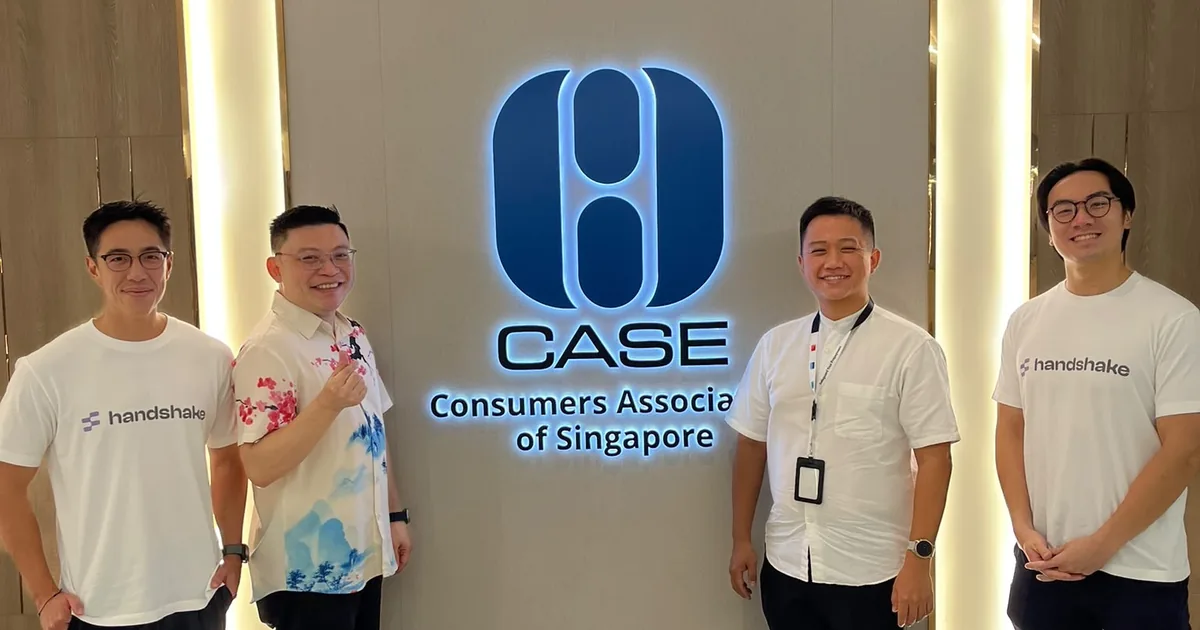

We are proud to be working closely with the Consumers Association of Singapore to make renovation payments safer for homeowners and interior designers.
CASE is a non-profit, non-governmental organisation committed to protecting consumer interests in Singapore through information, education and the promotion of fair and ethical trade practices. Home renovation is one of the biggest investments a household ever makes, and it is one of the key sectors CASE works hardest in. For good reason: almost all of a renovation is paid for before any of it is delivered.
Handshake was built for exactly that problem. We are a renovation escrow payment platform. Instead of paying your interior designer directly, you pay each stage of your renovation into an account that your interior designer cannot draw on until the work is done.
What CaseTrust accreditation already gives you
CaseTrust is the accreditation arm of CASE. Renovation businesses that are accredited are required to:
- Buy a deposit performance bond. If the business closes, winds up or goes into liquidation before your job is done, the bond pays your deposit back.
- Cap your initial deposit at a maximum of 20 per cent of the total contract value.
- Collect payments in phases at agreed milestones rather than in one lump sum.
CASE currently accredits more than 300 interior design firms.
How escrow protection works with CaseTrust accredited interior designers
The deposit performance bond is solid protection for the front end of your renovation. But it covers your deposit only. With deposits capped at 20 per cent under CaseTrust accreditation, the other 80 per cent of your renovation contract is paid out in stages over the course of the project, and the bond does not extend to any of it.
That is where Handshake comes in. By working with CASE, escrow protection is now available to every homeowner hiring a CaseTrust accredited interior designer. When you pay your interior designer through Handshake, the money goes into an escrow account instead of directly to the firm. These funds get released as the work gets done and as you approve each stage.
All payments on the platform are MAS regulated. Funds are held in a custodian account with DBS.
What this looks like on an S$80,000 renovation
Say your renovation is S$80,000, split across five stages at 20, 20, 25, 25 and 10 per cent: deposit, commencement, masonry, carpentry and handover. Every CaseTrust accredited firm caps that first payment at 20 per cent.
Your deposit is held fully in escrow. You pay S$16,000 into a custodian account on Handshake and it is held securely until work is due to begin.
After that, each stage splits in half the moment you pay for it. Half goes to your interior designer, and half waits in the account until you approve that the stage is finished.
An S$80,000 renovation, stage by stage
DEPOSIT · 20%
S$16,000 in
S$16,000 held
Nothing released until work begins
COMMENCEMENT · 20%
S$16,000 in
S$8,000 released
S$8,000 held
MASONRY · 25%
S$20,000 in
S$10,000 released
S$10,000 held
CARPENTRY · 25%
S$20,000 in
S$10,000 released
S$10,000 held
HANDOVER · 10%
S$8,000 in
S$4,000 released
S$4,000 held
S$48,000 of the S$80,000 is held in escrow rather than paid out.
Across an S$80,000 renovation, S$48,000 of it is held in escrow and protected.
Why your interior designer is paid half at each stage
Renovation firms need cash to carry out your renovation, because materials and labour have to be paid for at each phase. Releasing half of each stage when you pay it in gives your interior designer the working capital to keep the project moving, so your renovation runs smoothly and on schedule.
The other half stays safely held in escrow until the work is complete and you approve the release.
See how Handshake protects your renovation payments
Does your interior designer need to be CaseTrust accredited?
No. The same escrow workflow is available whether your interior designer is CaseTrust accredited or not. Your renovation payments are held in a custodian account at DBS and released stage by stage only when you approve each one.
Once your contract is signed and before your deposit is paid, connect us with your interior designer on WhatsApp. We will get them set up in minutes.
FAQ
Can an interior designer who is not CaseTrust accredited use escrow?
Yes. Handshake escrow is not limited to CaseTrust accredited firms. The split described here applies to CaseTrust accredited firms specifically. For firms outside the scheme, the full amount of every stage stays in the account until you approve that stage, which holds more of your contract. Our guide to renovation payment protection covers how that works.
Do homeowners need to pay to use Handshake?
Not at all. Handshake is completely free for homeowners. Interior designers pay a small fee which also gives them access to project and financial management tools on top of escrow protection, so there is nothing for you to pay at any point in your renovation.
See how it works for homeowners
Your renovation money held in a custodian account with DBS. Free for homeowners.


 WhatsApp us